
The Three-Legged Stool: Assessing Digital Maturity for SMB AI Success

TL;DR
Success in AI isn't just about buying the best software; it’s about ensuring your organization is ready to absorb it.
The Framework: Digital maturity rests on three legs: Capabilities (people/culture), Technologies (data/reporting), and Architecture (infrastructure/integration).
The Maturity Matrix: Organizations evolve through stages, Traditional, Bridge, Hub, Platform, and Native. Your stage dictates which AI tools (from GenAI chatbots to custom ML models) are actually feasible.
The Reality Check: For a typical SMB like Riverbend Mechanical, "winning" at AI doesn't mean building custom models. It means utilizing prebuilt, vendor-managed modules that match their current capability level.
The Goal: Align your AI investment with your readiness to avoid the "ambition without readiness" trap.
Last month, we proposed that the starting point for any AI use case begins with understanding how well your organization moves customers through all the activities required to deliver your product or service. A natural next step might be to then select the AI tool best-suited to your use case. In doing so lies the difficulty. There are many types of AI that all rely on varying levels of skill, technology, infrastructure, and so on.
Tech leaders, Satya Nadella, Chairman and CEO of Microsoft, and Marco Iansiti of Harvard Business School note in Democratizing Transformation that while companies all but ubiquitously invest in technology, returns are inconsistent. What differentiates winners and losers is a company’s capabilities, technology, and architecture. Success rests on the three-legged stool of digital maturity.
Not surprisingly, the ideal AI tools for your use case also depend on how digitally transformed your business is. Ultimately, the goal is to develop the capabilities, technology, and infrastructure for digital transformation in ways that involve everyone in the organization. Why? It is precisely frontline staff who are often closest to the use cases and have the richest insights into the ebbs and flows of the customer journey. Their insight, abilities, and tools at their disposal are essential inputs into productive AI adoption.
The Three-Legged Stool of Digital Maturity
Capabilities: The Human Side
Capabilities encompass the human side of digital transformation. Iansiti and Nadella observe that successful transformation requires developing digital and data skills beyond the IT department, building a culture of experimentation, and fostering process agility.
For SMBs, leadership and culture, training and development, and accessible tools are all relevant.

Technologies: Process Digitization
Examining technologies considers how well your organization integrates disparate digital systems and processes, handles, stores, manages, and governs that data, and makes decisions using reporting and analytics.

Architecture: The Foundation for Growth
AI only succeeds when your technology and your people are intentionally designed to work together. Large enterprises achieve this by spending millions on complex data platforms. SMBs just need the basics like organizing data, connecting apps, and ensuring your team can use them together.

What Digital Maturity Means for AI
SMBs’ maturity depends on the consistency of their capabilities, technology and architecture. Isanti and Nadella’s framework describes how firms evolve from Traditional, where technology is siloed and managed by IT, through Bridge and Hub, which link functions and share real‑time insights, to Platform, with a unified foundation of software, data, and AI, and finally Native, where AI is deeply integrated and democratized.
The matrix below summarizes many of the “symptoms” of each stage across the legs of the digital maturity stool, along with the feasible AI tools at each stage of maturity.
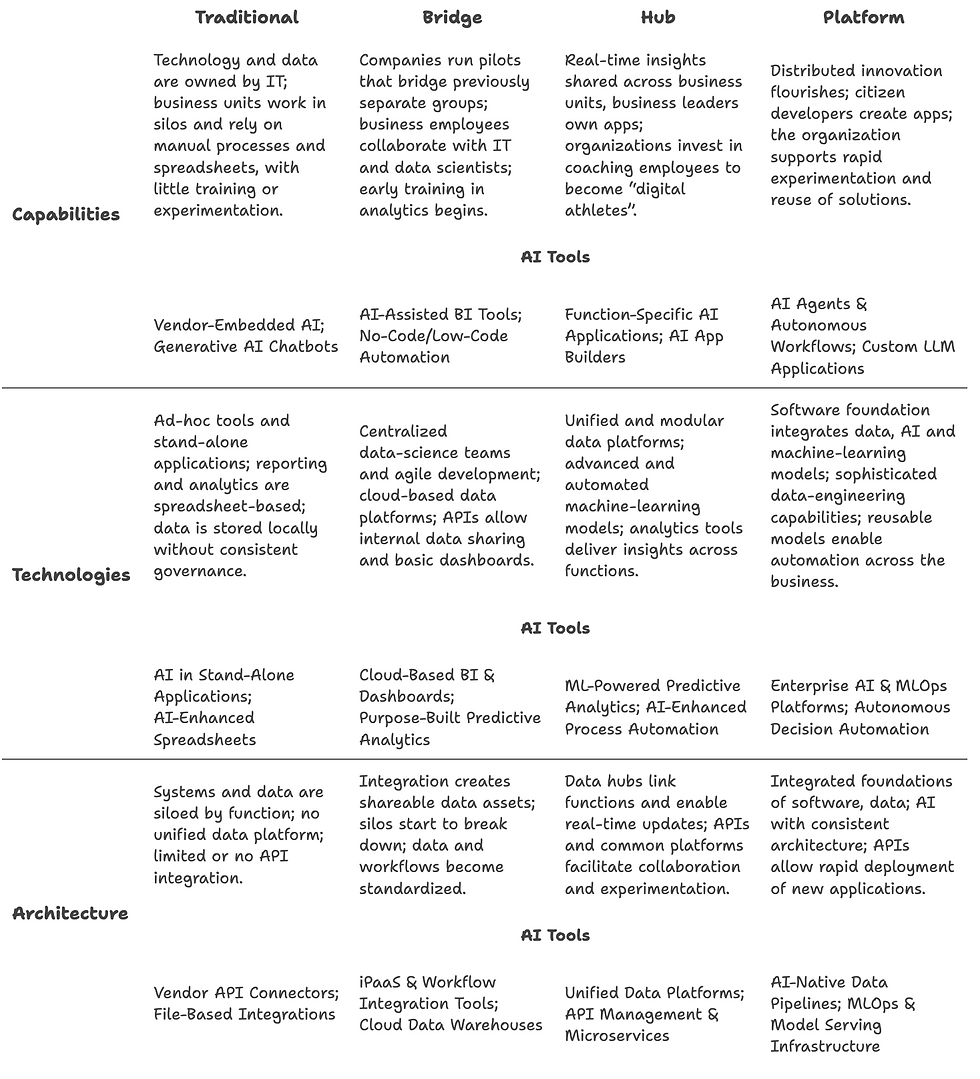
From Bottleneck to Blueprint: Scoping the Right Tool for Riverbend
In our last blog, we established that Riverbend Mechanical Services has a clear AI use case: scheduling optimization. Dispatch is the bottleneck. It is slow, highly variable, and dangerously concentrated in one person’s memory. An AI-enabled scheduling tool could read incoming job requirements, evaluate technician skills and availability, and optimize routing in real time. The use case is well-defined. But the use case alone does dictate the kind of tool to build or buy.
That is where the three-legged stool comes in. Before Riverbend spends a dollar on technology, it needs to answer a different question: What kind of scheduling tool can Riverbend actually absorb, operate, and sustain, given its digital maturity? Ambition without readiness is just a failed pilot.
Riverbend and the Three-Legged Stool
Recall that Riverbend is a 40-person, $12 million field service company. Its operations are steady, its phones ring constantly, and its business problem is well understood. What is less clear is its digital maturity. A humble look at each leg of the stool suggests that Riverbend sits somewhere between Traditional and Bridge.
Capabilities. Riverbend uses a CRM for intake and a separate job management system for execution. The dispatcher has years of institutional knowledge but no formal training in data tools or analytics. No documented protocol exists for how scheduling decisions get made. Staff involvement in digital processes is minimal. Technicians update job status in the field app, but most other processes are manual or handled over the phone. Digital skills are concentrated in one or two people, and there is no culture of experimentation or self-service analytics.
Technologies. Riverbend uses three distinct platforms: a phone-based CRM for intake, a field service management (FSM) app that tracks technician location and job status, and a QuickBooks-based accounting system for close-out. These systems do not talk to each other. The dispatcher mentally bridges the CRM and the FSM by monitoring both screens simultaneously. In short, a human links disconnected platforms. Reporting exists, but it is backward-looking and spreadsheet-based. There is no dashboard, no real-time technician status feed, and no data model that links job type to technician certification to drive time.
Architecture. The systems are siloed by function. There is no API integration between the CRM, the FSM, and accounting. Data does not flow between systems automatically. It moves through email, phone calls, and manual re-entry. There is no shared data layer that could feed an AI model the inputs it needs, such as job history, technician certifications, average drive times by zip code, or customer priority flags.
What This Means for Tool Selection
What Riverbend can absorb is a prebuilt, vendor-managed scheduling optimization module embedded in its existing FSM platform. Several leading field service platforms, such as ServiceTitan, Jobber, and FieldEdge, now include AI-assisted dispatch features that recommend technician assignments based on location, skill match, and current workload. These tools are configured through a user interface rather than code. They require no API integration because they live inside the same platform that already tracks technician locations and job status.
The dispatcher does not need to become a data scientist. She just needs to learn one new screen. This is not a consolation prize. It is the right tool for where Riverbend sits.

Where Do We Go From Here?
This diagnostic tool is a starting point, not an end in itself. An honest examination of your digital maturity can do wonders. It allows you to align investments in training, technology, and architecture that align with the business goals an AI application supports. From here, we’ll dive into specific types of AI tools. We’ll explore which generative AI, analytics, and automation tools make sense for each functional area and maturity level.
Recap
Success with AI isn't just about buying the right software; it depends on an organization's "digital maturity."
Digital maturity rests on three critical pillars: Capabilities (people and culture), Technology (data and reporting), and Architecture (infrastructure and system integration).
The ultimate goal is to use a maturity diagnostic to ensure that investments in training and infrastructure directly support the specific business goals identified in your AI use cases.
We value your insights: If you're interested in joining our AI community of practice for small- and medium-sized businesses, please provide your information via the link below.
Dan Lindberg is the founder and principal of Applied Economic Insight ® LLC. His insights have been featured in Discover Artificial Intelligence, Business Economics, and Homes.com. He served as the first Director of the Applied AI Lab at Waukesha County Technical College and currently teaches business analytics and data science courses at Marquette University and Alverno College. In 2022, Dan won the Contributed Paper Award from the National Association for Business Economics. Dan has a Master's Degree in Applied Economics from Marquette University and has over a decade of experience consulting in predictive analytics.
Raj Muthupandiyan is an applied technology advisor and the founder of Arivu LLC, where he is dedicated to turning the complexity of AI into practical results for the SMB community. With over two decades of experience across manufacturing, financial services, and service-based industries, Raj understands that for a small or mid-sized business, technology is only valuable if it drives growth and operational efficiency. He focuses less on the "hype" of emerging tools and more on the real-world constraints that leaders face, designing solutions that are secure, sustainable, and realistic. Raj holds a Master’s degree in Computer Science from Marquette University.


Comments